Sunday, July 2, 2023

The Eye of the Storm: 2023 Western States 100 Run Report

In the high country at Western States

I've reached the proverbial "eye of the storm"; the moment of calm betwixt two raging tempests...

As I sit here, calmly enjoying an early summer day, I am filled with both a sense of satisfied contentment for what I have just accomplished, but also a sense of palpable trepidation for what is to come. This past weekend, I successfully navigated my way through the mountains and canyons of northern California along the Western States 100 course to again cross the finish line in the town of Auburn...and thus complete my 99th official ultramarathon. This was my second running of this event, and this year, I bested my previous time by almost 50 minutes. The snow conditions in the early miles were quite similar to those in 2017, however the overall temperatures during the mid-day, were much more forgiving this year. As a result, I was able to move well, and move consistently all day...and nibble away at my previous time. The ultimate result was a successful day, with no major blowouts, injury scares, or other issues. I sit here today, just 4 days later, feeling quite well and ready to run again.

If the story ended there, then it would be a worthy of a celebratory drink on the back porch, with feet elevated, and accompanied by well-earned sense of achievement. But, the story doesn't end there.

In just over two weeks, I'll be again lining up for another 100-mile jaunt through the wilderness...but this time well over 9000 feet, and with almost twice the amount of elevation gain. I will be lining up in Silverton Colorado, for the annual running of the Hardrock Hundred Endurance Run. The good news is that I have run Hardrock before, so I have an idea of what to expect out there. The bad news is that this year, I will be going in the other (and arguably harder) direction....and there will be significant amounts of snow still on the course (when I ran the course in 2018, there was almost no snow at all).

So, I could fret. I could worry. I could panic. But instead I choose to breathe in the cool air, and be grateful for what I have been able to do in California, and what I have the honor and privilege to be a part of in Colorado. I know it will be difficult and challenging. I know it will require an enormous effort. I know it will take everything I have to reach the "rock" (finish line). So....I will show up ready and willing to head forth into the wilderness bearing a smile, an eager spirit of adventure, and of course, my trekking poles.

A Brief Race Recap

I arrived in Tahoe City on Wednesday, giving me two full days to relax and take care of race logistics. One thing that was noticeably different from my past running at Western States, was that upon arrival, I already knew that I was in the starting field. There would be no nervous nail biting as I wait to hear if I might come off of a wait list. This made the entire experience quite different from what I had in 2017. I could enjoy the pre-race festivities, check out the gear store, and otherwise let my mind relax. I spent most of the day Thursday, mulling around the Olympic Village, and shopping for WS gear...and then on Friday, I took care of my drop bags. At 2:00 PM on Friday, I attended the runner briefing and learned that we should expect a lot of snow up top in the high country, but much cooler temps in the canyons as compared to normal. I wasn't too worried about the snow, but I knew if I had to contend with temps like I had in 2017, it was going to be a rough day. Hearing that the expected highs (even in the canyons) wasn't supposed to top 85 degrees, was very welcome news.

Another thing that made this year's running different was that was I sharing a rental condo with some friends from back east (one of which was also running). In addition, I had a planned pacer that I would be picking up at mile 62. This pacer, Deb, works in the same department at the University and had offered to pace when I first learned I'd be running (last December). Typically, I don't use pacers much anymore, but I knew that having one for Western States is really beneficial. I've run with Deb many times back home on training runs, so knew that she would be excellent company in the wee hours of the night as well.

After the runner briefing, and having dropped off all of my gear, I headed back to my airbnb, ate a healthy serving of pasta, and went to bed as early as I could. Alarms set for 3:30 am. 

One quick important note: Just four weeks prior to the race, I had run about 50 miles of the Western States course with my friend from back east, Melissa, as part of the "Training Camp". We had a grand ol' time, but the snow was definitely still quite expansive in places. I had heard that in the 4 weeks leading up to the race, the temps had been high and much of that snow had melted. But, from just looking up at the high peaks towards and the first 4 miles of the course that lay ahead, I knew we were still in for quite a bit of the white stuff. Melissa, was also in the starting field for the race this year.
Western States Training camp with Melissa (Late-May)
Western States Training camp with Melissa (Late-May)
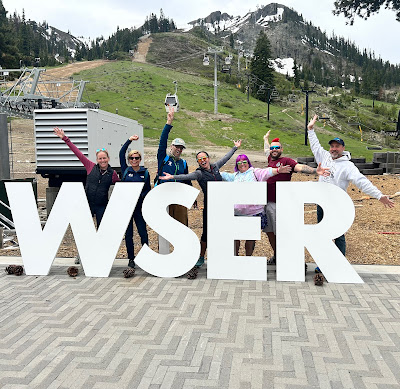
Hanging out with the gang near the start line
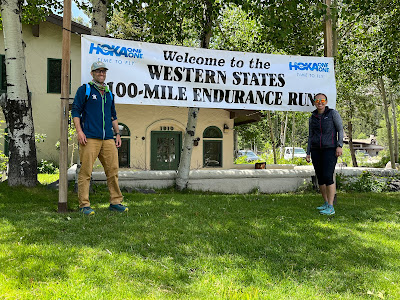
Melissa and I getting the quintessential "welcome" shot

The new start line (moved a few hundred meters)
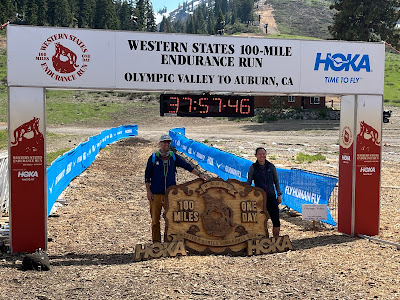
Pre-race photo at the start with Melissa
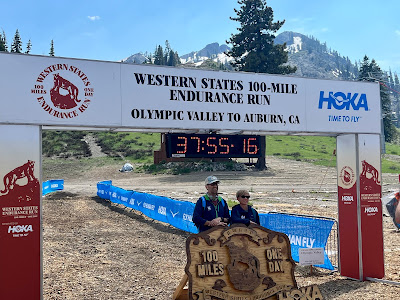
Pre-race photo at the start with Deb
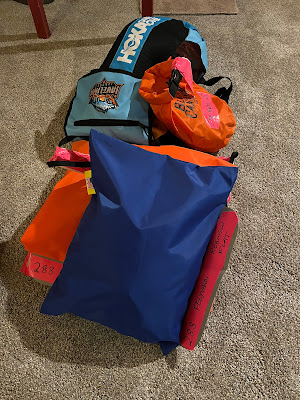
Drop bags packed and ready
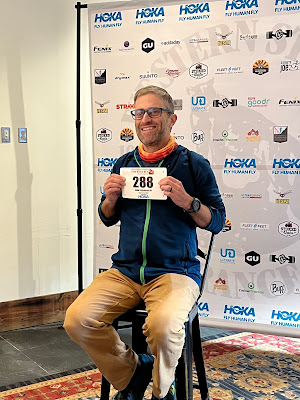
Getting my official race photo
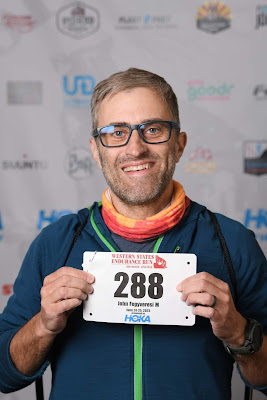
2023 official entrant photo
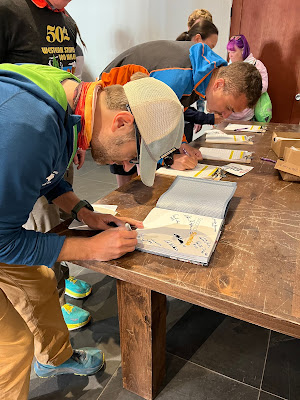
Signing the runner book and other paperwork
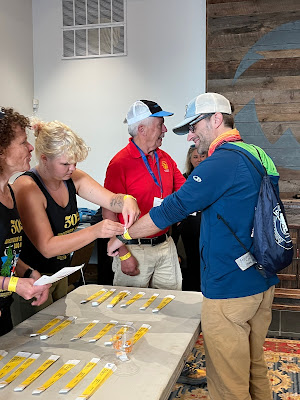
Getting my wristband...it's official!

Race morning starting about 3:00 am when we all woke with the pre-race jitters. I put down a healthy bowl of muesli and drank two full bottles of water (I was trying to be super proactive with respect to hydration this year). We all headed over to the village about 4:00 and had an hour to kill until the gun went off. About 5 minutes before the start, I said "see you later" to Deb, and headed to the start with Melissa. A look up at the snow levels on the peaks revealed an almost identical amount of snow that we had in 2017. I went back after the race and compared photos from both years, and it's frankly remarkable how similar the snow levels actually were.
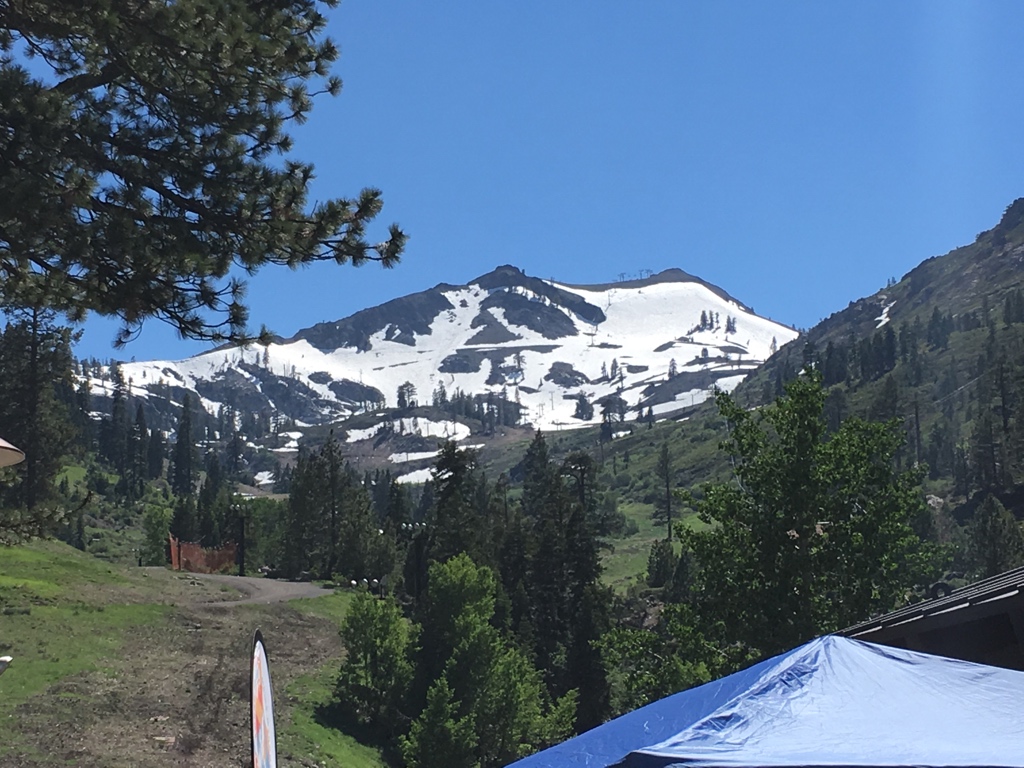
Snowy peaks at the start in 2017

Snowy peaks at the start this year (nearly identical)
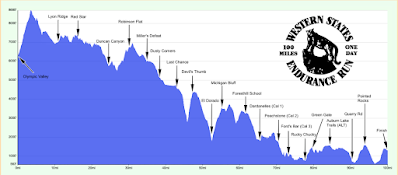
Western States Elevation Profile

I shared a few last minute words with Melissa, wishing her luck and then...promptly at 5:00 am, we were off! I trotted my way up the approach road making use of the snow-free terrain while it lasted. About 2 miles up the climb though, we left the comfort of the road, and headed straight up the snow fields towards the escarpment (the highest point on the course). I didn't have my split times from 2017, but knew I had hit the top a little over an hour into the run. Similarly, I hit it just a few minutes past the hour this year. I made sure to stop again at the top, turn around and admire the beautiful sunrise. I looked down briefly to see if I could spot Melissa behind me, and caught a quick glance of her not too far behind.

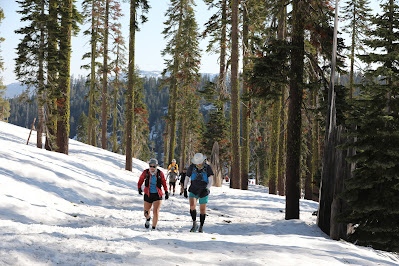
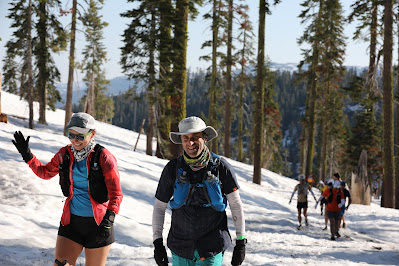
As expected, on the backside of the climb, the trail was clear for about 1/4-mile, but then immediately turned into a snowy wonderland almost exactly like what I went through in 2017. For the next 10 miles, all the way to the first aid station at Lyon Ridge, we had almost continuous snow. Every once in a while, we'd get a few hundred feet of trail, but we were almost exclusively slipping and sliding along snowy drifts. I manage ok on snow (given all of my experience back on the PCT), and kept a steady pace. I monitored my heart rate carefully to make sure I didn't get carried away though. It's easy to push a bit hard and burn too many "matches" if you're not careful. Dealing with snow can sap a lot of energy if you just try to plow through with reckless abandon. When my heart rate started to climb, I eased back, all the while not worrying about how I was passing, or who was passing me. There was a lot of race left.

The first aid station took a while to reach given the conditions, but once there, I topped off my bottles, grabbed some snacks, and was out rather quickly. For the next 6 miles to the Red Star station, the trail continued to be heavily covered with snow, but significant gaps were starting to open up. The staggered nature of the snow made it hard to settle into a rhythm though. When I hit Red Star, I really had to use the porta-potty, but it was in use when I arrived. I decided it was worth it to wait, so lost about 5 minutes at this aid station. In retrospect, those 5 minutes would end up being the difference between a sub-27 hour finish...but so it goes with races I suppose. I guess I could have just used "the woods" for my bathroom break. ¯\_(ツ)_/¯ 

Cruising along some clear single-track in the high country (snow visible in back)

Climbing Cougar Rock

Climbing Cougar Rock

Heading out of Red Star, we began the slow descent down to Duncan Canyon. We were told two things about this stretch by the race director. First, once we began descending, it would be mostly snow-free. Second, the creek crossing at the bottom was "waist high". The descent was the first time I felt like I could open up a bit and it felt great. Coming into the Duncan Canyon aid station around mile 25, I was feeling good, floating along, and optimistic that most of the snow was behind me.

Nearing Duncan Canyon Aid Station

Nearing Duncan Canyon Aid Station (and moving well)

Coming into Duncan Canyon Aid Station (and moving well)

I left Duncan Canyon for the river crossing, and was feeling good. On the many descents in this section, I was moving somewhat conservatively and getting passed a lot, but I was doing really well on the climbs (passing just as many). Part of the reason I was a bit timid and somewhat "afraid" to open up too fast, was that during the training camp just a few weeks prior, I took a really nasty fall. I was going a bit too fast, and clipped my toe on a rock and went hard into the ground. This fall nearly de-railed my entire "Double" and I was actually worried I wasn't going to be able to run. I had fallen monumentally hard on my right knee, and had to take a week off from training while I recovered. Thankfully it did heal in time, but it really spooked me, and had me constantly reminding myself to "watch the trail", and "keep the pace easy". As as consequence of my spill, I ran the race with leather biking gloves in case I did fall again.
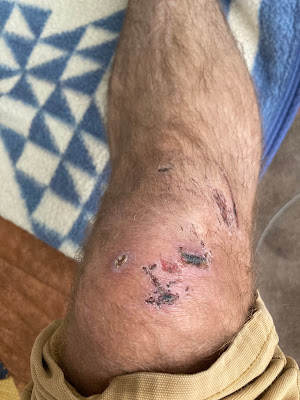
My right knee just two weeks before the race
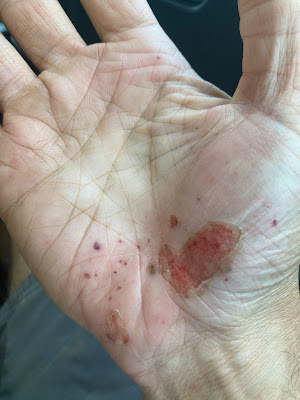
My right hand before the race

When I got to the Duncan Creek crossing, a rope had been set up to help runners get across. When I stepped in, the water immediately went up to my stomach and it was a bit of a surprise. The water was also incredibly cold and took the air right out of me. Once on the other side, it took me a few minutes to catch my breath again.

The climb up out of Duncan Canyon to Robinson Flat was the first significant climb on the course after the  big haul up to the escarpment at mile 3. I pushed through it consistently and strongly and in less than an hour, I could hear the people cheering at Robinson Flat. This would be the first aid station where'd I'd see Deb and Melissa's crew. I planned to sit briefly, to assess my gear, and then move on in under 4 minutes. About a half-mile before the aid station, I had navigate one last section of full snow before hitting the road. I was shocked to see how clear Robinson Flat was of the white stuff, given just 4 weeks prior the drifts were over 8 feet tall. 

I rolled up to all of my friends, sat down and immediately asked, "How far back is Melissa?" I was then told by her crew, that based on her live tracking, she was in danger of missing the time cutoffs. I knew Melissa was worried about the snow slowing her down (as well as the altitude), but I also knew that if she could get through it, she'd easily make up time after Robinson Flat when the snow was supposedly all gone. I told her crew that I was rooting for her, and then filled my bottles and rolled out. As I made my way down the road, I had fond memories of starting this stretch with Melissa just a month prior during the training camp. 

For the next ~13 miles, the Western States course presents runners with probably the most beautiful and runable stretches on the entire course. At one point a volunteer was directing runners at a junction and he told me, "get ready for about 5 miles of pure awesomeness". He wasn't lying. I had a smile on my face for the entire stretch...just soaking it in. I ran most of it, and tried not to look at my watch too much. This section was recently burned in an expansive wildfire, so there were considerable exposed areas, but the temps were still behaving. In the back of my mind, I was starting to get nervous about the looming canyons.

Starting around mile 44, the Western States course presents runners with what I believe is the most difficult stretch of the entire race: The dreaded Canyons. The "Canyons" consists of three significant down-and-ups in a row. Each canyon involves anywhere from 1600 feet, up to 2000 feet of descent....followed immediately by an equivalent climb. In 2017, the canyons absolutely kicked my ass. Of course it was also over 100 degrees at the bottom of each, so I simply got sapped by the "oven-effect". This year, we were presented with much more modest mid-80s.

As I dove down into the first canyon, I quickly recalled the short and steep switchbacks. They always seem to go on forever and the river at the bottom never seems to come. I firmly believe that the first canyon is the worst of the three despite not being the most elevation loss/gain. The climb out up to Devil's Thumb is steep, and soul-crushing. In 2017, I nearly quit the race at the top after being completely drained on the climb. This year, though, I moved steadily, and consistently and was frankly shocked at my progress moving up to the Thumb. I probably passed a dozen people on that climb and once on top, I was already running smoothly again. I only spent a few moments at the aid station was on my way to the second canyon (El Dorado) quickly. The descent and climb out of the second canyon does lose/gain more total feet, but the gradients are noticeably less. This means the climb is longer, but I think much more forgiving. I put my music on in my earbuds, put my head down, and plowed my way through the second canyon as quickly as I could.
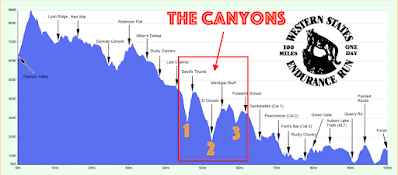
The dreaded three "Canyons"

At the top of the second canyon, runners are welcomed at the Michigan Bluff aid station. This stop is quite lively and was a really nice welcome. I spent a few minutes there re-hydrating and putting down some more substantial solid food. As I left the station, I knew I had just one final canyon remaining, and the easiest of the three. Then, in less than 6 miles, I'd be at Foresthill and picking up my pacer, Deb. Once runners pass Foresthill, the entire feel of the Western States course changes. There are very few big climbs left, and the entire course becomes noticeably more run-able and subdued. I was hoping to really try to run a lot of the final 40 miles this year (as opposed to 2017 when I walked a fair amount of those miles)

The final canyon went quickly and I noticed that sun was starting to get quite low in they sky. I remembered in 2017 I had reached Foresthill just as I needed a headlamp, and was hoping to make it there this year a little sooner. My watch told me that sunset was about 8:40 pm, so was aiming to come in under that if I could. I didn't know my exact time from 2017, but guess it was probably about 9:00 pm.

I descended quickly down to the creek crossing of the final canyon and had to again get my feet wet, but then the climb up to Foresthill went incredibly quickly. In what seemed like just a few minutes I was already on the paved "Bath Road" that leads up to town and feeling surprisingly good. I topped out on the climb about 1/2-mile from the aid station and picked it up a little to a nice running pace. As I approached the station, I looked at my watch and it read 8:38! I had made it before dark!

I immediately spotted Deb and got pumped for the company. But then...I also caught something unexpected out of the corner of my eye. My sister-in-law and her partner had driven up from their home outside Sacramento to cheer me on! It was so great to see them and I eagerly hugged them both. I also learned from Deb that Melissa had missed the cutoffs and her entire crew had left to assist her. This news definitely saddened me, but there wasn't much I could do about it. I told myself that I would keep Melissa in my thoughts over the next 40 miles and try my best to "bring her along with me".

Deb and I geared up quickly, restocked our fuel and waters, and then headed out of town and into the night. I said goodbye to my family, switched on my headlamp, and began the steep descent down the first of the "Cal Street" aid stations.

"Rocking Out" while arriving at Cal Street aid station 

Over the next 16 miles, Deb and I shuffled along the river, at much lower elevations, trading good stories. I was able to run most of this stretch and it felt so good to have some company to chat with. We began ticking off aid stations one by one, and within just a few hours, we were approaching the famous Rucky Chucky river crossing. In 2017, I hit this crossing feeling like absolute death. This year, the two of us were feeling good, and I was over 20 minutes ahead of my time from 2017. We hit up the aid station at the crossing, and then hopped in the boat for the quick assist across the river. Once on the other side, I quickly flipped through my drop bag, and then we began the climb up to Green Gate.

2017 crossing...feeling awful

This year...feeling so much better!

At green gate I was flooded with the unpleasant memories of my fall 4 weeks prior. During the training camp, I had fallen just above the gate, and then waddled my way over 5 miles down the trail to the Auburn Lakes Aid station in order to get a ride out. I was in really bad shape, and convinced that I had ruined my race. Needless to say, I was having some awful conversations with myself during those training camp miles. But...now, now I was feeling good, my knee was behaving, and Deb and I crushed through this section making up another 10 minutes on my 2017 time. It was during this stretch though that we noticed that we were both getting a bit sleepy. While the 2-3 am window of a 100-miler is my favorite, it is also the sleepiest.

We pushed through Auburn Lakes and on to Quarry Rd where we were welcomed by Scott Jurek manning the station. It was an unexpected surprise for sure. As we left Quarry Rd, we noticed it starting to get light out. We had made it through the night! It was somewhere in this stretch that I saw the 24-hour time pass by and smiled to myself thinking about the last of the silver bucklers finishing (sub-24).

We made our way up the climb to Pointed Rocks and Deb took a few nice sunrise photos
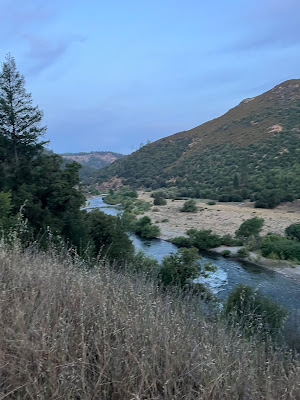
Mile 91-ish
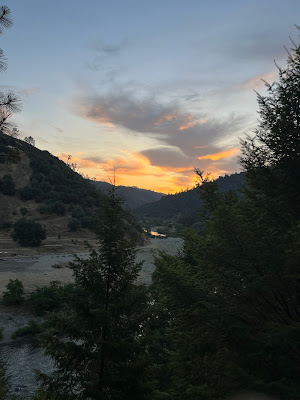
Mile 91-ish

When we arrived at the top of the climb at Pointed Rocks, we took one last mini-break to refuel, rehydrate, and use the facilities. I told Deb that once we left, I had no plans to stop in the final ~5 miles. When we headed out, the sun was starting to warm us up, and my pace quickened. Over the next 2.5 miles to the No-Hands Bridge I ran fairly quickly, and felt simply fantastic. I again passed several other runners in this stretch. When I hit the bridge, it felt magical. Deb and I ran across, all while hootin' and hollerin'. I was shocked at how much better I felt at this point than I did in 2017.


As I made my way up to Robie Point on the last climb of the course, I was monitoring my watch obsessively. I tried to convince myself that I could make it to the finish under 27 hours, but also knew to do that, it would require an almost impossible effort. As I did the math, I realized that I was going to need to run two 8-minute miles, all while climbing over 1200 feet, and with 100-miles on my legs. By the time we made it to the top of the climb and back on the paved road about a mile from the finish, I knew a sub-27 was out of reach (it would have required a sub-6 minute mile). Rather than fret about it, I settled into an easy-paced run alongside Deb, and we cruised down the road on our way to the high school with smiles on our faces.

When I arrived at the final track, we ran around it together soaking it all in, and just before the finish....Deb pulled away off the course. I crossed the line in 27:04:56, almost 50 minutes faster than in 2017. I had made up an additional 25 minutes over the last 10 miles.

I walked over to the grass, promptly laid down, and took a well-deserved rest. Deb grabbed my drop bag, and I changed into more comfortable clothes. For the next few hours I cheered on additional finishers and watched as the last of the runners came in during the golden hour.

The finish....still feeling good.

Accepting my award
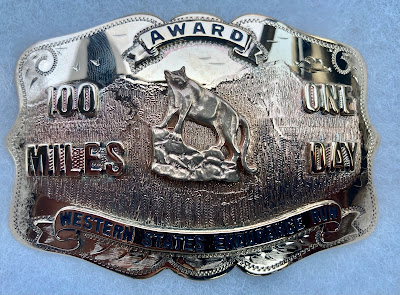
The "Prize" - the Western States Buckle

The biggest takeaway from my run this year is that I truly paced myself correctly. I knew that I had Hardrock coming in just a few weeks, so intentionally wanted to be conservative. Yet, I was still able to reach the finish almost 50 minutes faster than in 2017. Certainly some of this was due to the cooler temps, but I also think that by taking it a bit easier earlier on, I effectively "banked" some much needed energy for later in the race. I was able to keep moving well through the night, and into the second morning. I was able to have good conversations with Deb and not feel like absolute death over the last 20 miles. By Monday, just two days after the run, my legs already felt almost completely normal.

So now...I look ahead to the next tempest: The Hardrock 100. I look ahead with anticipation, but with an enormous amount of humility and respect. I know just how difficult Hardrock is, especially with tired legs.  My mission these next two weeks is to go easy on myself, don't push things, and try to recover as much as possible.

....onward!

Friday, April 21, 2023

A Grand Adventure

Sunrise near Roosevelt Lake

Much like with the ultrarunning or thru-hiking worlds, if you spend any time within the greater domain of motorcycling (particularly adventure motorcycling), you will come to learn of various challenges, traditions, and goofy exploits. One only need spend a few hours peeking in on motorcycle forums, or watching a handful of online videos to quickly observe many of these said challenges and traditions.

It's really not all that surprising as with any hobby, there's always those that perhaps dive in a little too deep (which I of course am also guilty of doing myself). With respect to adventure motorcycling, there are certainly the obvious challenges, like visiting every state, or riding across a specific country (or countries).  There's a well-known route in the US know as the Trans-America Trail that features thousands of miles of roads and trails that supposedly make for an incredible adventure. Many of the US states (particularly out west), also have what are known as BDR's or Backcountry Discovery Routes. These routes are much more technical and more appropriate for legitimate dual-sport style bikes. Incidentally, the AZ-BDR goes through Flagstaff just a few miles from my house. I've ridden many miles of the route, and much if it is beyond my skill level.

There are several well know routes that riders will take on as a "Rite of Passage". These include the Tail of the Dragon route through the southern Appalachian Mountains, the Skyline Drive in the Northern Appalachian Mountains, the Natchez Trace Trail in the Deep South, or the Going to the Sun Road up in Glacier National Park. Any place there's a scenic and twisty route, motorcyclists have likely penciled it in at one point on their proverbial To-Do list. Here in Arizona, we have several such twisty roads, with the Coronado Trail being one of the more well-known. It's about 100 miles of winding and curvy paved road that climbs up through the White Mountains, topping out about 9000 feet. It's supposed to offer some of the best views in Arizona.

Beyond the single road stretches, many more advanced motorcyclists will plan for years for what's known as the the pinnacle of Western Hemisphere challenges: the Pan-American Highway. This route begins in Ushuaia, the southernmost accessible point in Argentina (and the Americas), and goes all the way up to Prudhoe Bay Alaska. This ride is essentially one of the ultimate grand-daddy "thru-rides" of the motorcycling world.

Aside from the obvious scenic or adventurous routes, there are also a slew of what I would call, "challenges". Much like with the "Cannonball Run" in the auto world, there are various iterations of Cannonball rides involving two wheels. In essence, this challenge involves getting across the US as fast as possible on two wheels. And yes...there's even a Scooter version of this challenge where all riders are limited to 150cc (or less) scooters.

One well known challenge taken on by many riders is what is affectionately dubbed: 

"The Iron Butt Challenge"

There are several variations of this challenge, but the standard version essentially challenges the rider to cover 1000 miles on their bike, in under 24 hours. There is an entire website and association dedicated to keeping the rules up-to-date and published, as well as keeping all records of successful rides. In order to successfully complete the Iron Butt Challenge and be recognized by the Iron Butt Association, you must keep detailed records along your ride. This includes all fuel receipts showing date/time stamps, as well as photographs of your odometer with said receipts at each top. In addition, any sort of GPX track of your ride is certainly recommended. The documentation process is arduous and involves several spreadsheets, and forms that must be sent in and certified. The website detailing this challenge (and the other variations can be found here:


Completing 1000 miles in 24 hours may not sound wildly difficult. It essentially means one must just average only 42 miles per hour. However, every stop eats into that average. So, every fuel up (which are much more frequent on a motorcycle), every stop to eat a snack, every stop to stretch your legs or take a photograph, every single stop.....chews into that average. Effectively, this all means that in order to actually complete an Iron Butt Ride, one must plan on banging out long stretches at high speeds in order to bank some time. Breaks have to be kept to a minimum and kept efficient (much like a race aid station). This challenge also means that you need to actually have a motorcycle that can ride at decent speeds for long periods of time. A small, 185cc dual-sport bike just isn't going to cut it. What's really mind blowing, is that there is actually a version of this challenge which involves 1500 miles in under 24 hours (which means averaging over 62.5 miles per hour!

So what does this have to do with me....

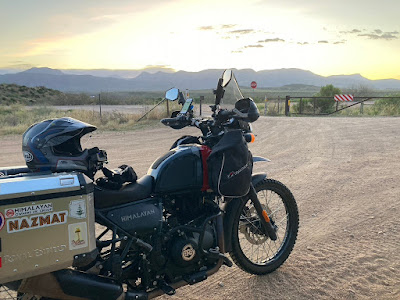
Well a few months back, I came to learn of this challenge, and decided I wanted to try it. My quick disclaimer here is that my motorcycle is not a great highway bike. I own a Royal Enfield Himalayan, which is a single cylinder, 411cc thumper. This bike will go all day at 60-65 mph, but once it gets up to 70 it starts to strain a bit. So for me, if I were going to attempt a true 1000-mile challenge, I wanted it to be about trying to stay on more rural and scenic secondary highways where I wouldn't be contending with traffic going 85+ miles per hour (i.e. the Interstate Highways)

With this said, I decided to commit to attempting this challenge at some point, but I decided to "rebrand" it as a "Grand Ride". This is an obvious and intentional play on words, as I would be aiming to cover 1000 miles, with a focus on the scenery and landscapes (not the speed and time). Now of course, I would still aim to come in under 24 hours to officially complete the challenge, but even if I were to finish in 25 hours, I would still be content.

Thus....the AZ GRAND RIDE was born.

Initially, I had hoped to do this ride a bit earlier in the year, but given the intense winter we had in Arizona, it simply wasn't possible. I began to notice an open Friday emerging on my calendar in mid-April and decided to pencil it in as my tentative attempt date.

So, all that I needed to do now, was plan an appropriate route. As I noted, my goal was to have a route that was not only 1000 miles, but made up of the most scenic sections I could combine, that also featured secondary highways that I could hopefully go 60-65 mph on consistently. I also wanted a route that would have me start and end at home. In other words, I wanted to complete a very large loop route. 

After many hours of playing in various mapping programs, I ultimately came up with what I thought would be the ideal route. This route clocked in at 1009 miles (giving me a few miles of buffer), started and ended at the gas station 1 mile from my house, followed along scenic routes, had long stretches of secondary highways, and also featured about 100 miles of twisty mountain roads as a capstone section for the route. This route would also have me traveling through just about every ecosystem of Arizona including the high Colorado Plateau, the Southern Deserts, the White Mountains, Navajo Nation, Monument Valley, and several large Volcanic Fields. On paper, it looked epic. It also had regularly spaced gas stations that would allow me to fuel up enough to not have to carry any spare fuel. The southernmost point would take me down close to Mexico, and the northernmost point would have me just 3 miles from the Utah border. The only downside with this proposed route, was it would require about 100 miles of riding along the I-10 Interstate. I wasn't thrilled by this prospect, but it was really the only way to get me across the southern portion as efficiently as possible.

AZ Grand Ride (~1009 Miles)

About two weeks before the my tentative ride date, I took my Himalayan out of winter storage, did a full inspection on it, and took it out for several test rides. I was very careful to properly winterize it the previous December, so thankfully, it was in great shape. With that said though, I was still a bit nervous about subjecting the bike to 1000 miles of riding in one go. It did have almost 9000 miles on its odometer (which is a fair amount for a bike). I checked every bolt, connection, wire, and potential point of failure. By every measure I could tell, the bike was in excellent shape, and it was either now or never if I was going to attempt such a ride.

De-winterized and ready for a proper challenge

And so...I made the decision to go for the Grand Ride attempt. I carefully planned all of the gear I would carry such that I would have what I would need for every weather situation. I would also carry spare tubes, and all of my tire repair equipment. I would carry my extended tool kit and a few spare parts that I normally would leave at home. Lastly, I decided to pick up a small satellite tracker in case I were to get stranded in a really bad situation. This tracker had built in emergency SOS beacon on it, but also would send 10-minute tracking points to a publicly available website that I could then use as additional documentation for my ride. The device I bought was an InReach Mini 2.

When deciding what time of day to actually start my ride, I vacillated on a good start time. Part of me wanted to wait until after sunrise, but then I would be likely riding for several extended hours at night on the back end. If I started too early though (i.e. midnight), I'd likely be really sleepy and still have over 6 hours of darkness during the coldest part of the night right at the beginning. Even a strong coffee wouldn't help me there. So, I decided to split the difference. I would go to bed somewhat early, and plan to start my ride some time around 2:00 or 3:00 am. This would mean I'd have about 3 hours of cold and dark riding at the start when I would be the most fresh, and then would hopefully only have a few hours of riding in the dark at the very end (when I would also hopefully be fueled by adrenaline).

And so....at exactly 3:11 am, on April 14, 2023, I filled up my gas tank a mile from my house, snapped my official "start photo", and began what would ultimately be a true (and literal) Grand Adventure.

My official "Start Photo"

At the start....Mile 0

The first 75 miles of the ride would be cold and I knew it. I prepared for this by drinking plenty of hot fluids before I left, and by layering up as much as I could. I even put hand warmers in my gloves. I knew if I just made it to Pine, AZ (about 80 miles in), the temperatures would warm significantly as I will have dropped over 2000 feet down in elevation just as the sun would also be rising. I've ridden the 75 miles along Lake Mary Road in the cold before, so I knew what to expect. My biggest fear was actually wildlife as this section of highway is notorious for elk movement. So, I had to be extra vigilant. Thankfully, I was fully caffeinated, and fully alert...and the miles went by fairly quickly. One thing that I had forgotten about my planned route, was that I had to add two small detours in order to properly make sure that it was over 1000 miles. One of these detours wouldn't come until the very last 50 miles when I would need to swing through the Sunset Crater/Wupatki scenic loop. But, the first small detour, was actually around mile 20, and I had completely forgotten about it. This detour was short, and only added about 5 miles to the route, but had me looping off of Lake Mary Rd. around Mormon Lake.

Normally, I would have loved this little detour, but given the cold temps, it came as a bit of a nuisance as I just wanted to get down off the high elevations as soon as possible. In addition, this was the one section of the entire ride, where I actually was presented with a small patch of ice, and it was terrifying. Some snow melt off of the flank of Mormon Mountain had run across the road, and when I came upon it, I was going too fast to stop....and had to just ride across it. I thought for sure I was going to slide out, but thankfully made it through without incident. Needless to say, it certainly woke me up and I went considerably slower through the rest of the detour until I was back on Lake Mary Rd.

A cold morning coming down the Mogollon Rim

Mormon Lake detour

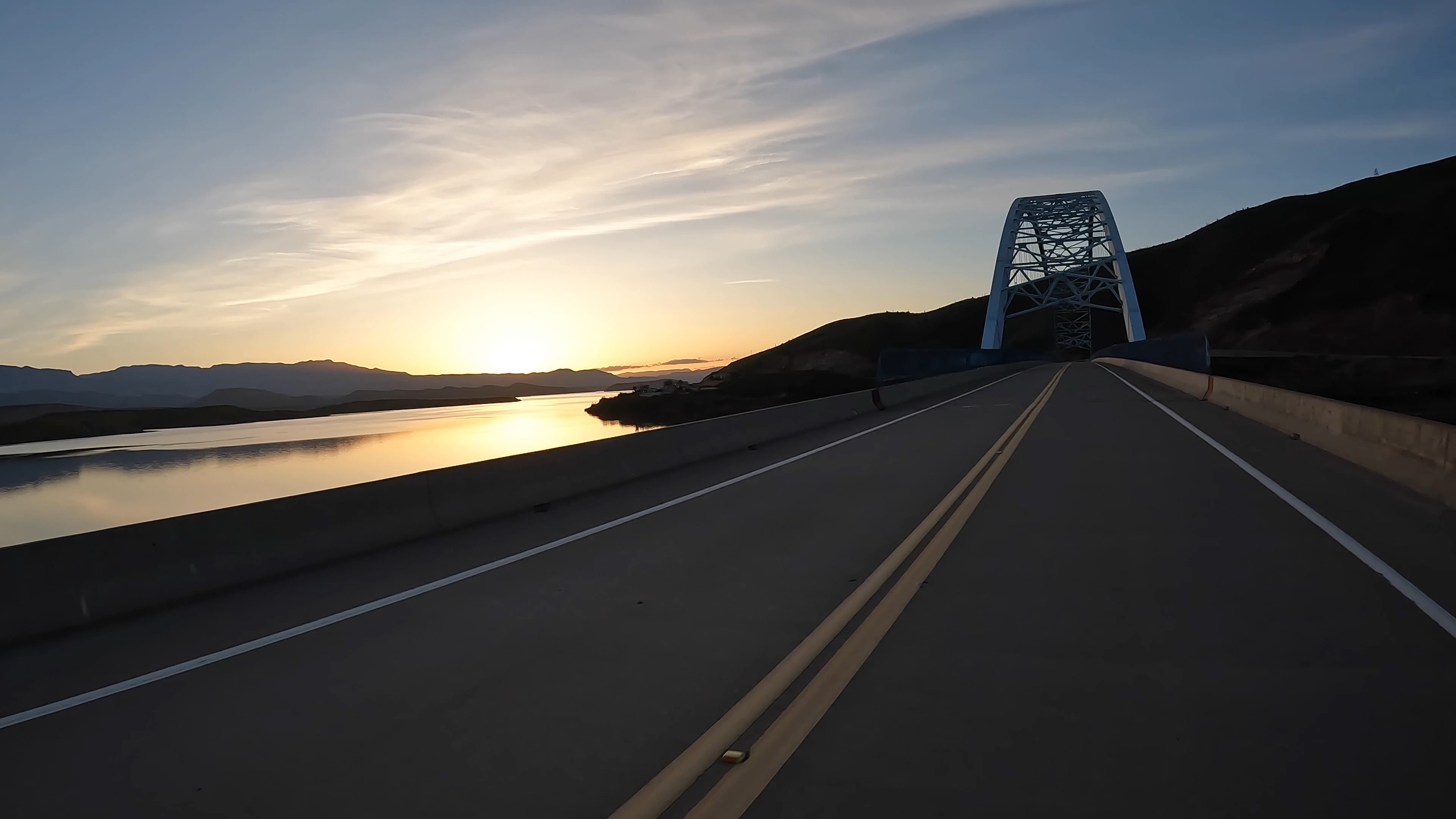
Once I made it down off of the Rim and into Pine, my fingers finally started coming back to life. As I weaved around the town of Payson and down towards Roosevelt Lake, I was starting to get hints of light creeping in over the eastern horizon. I timed the ride somewhat perfectly as the sunrise happened right as I was crossing the Roosevelt bridge and skirting along the shores of the lake. It was quite lovely to see the sunrise, contrasted with the water of the lake, and the saguaro cactus on the hillsides.

The route from Payson down along Roosevelt Lake

Crossing the Roosevelt Bridge at sunrise

Saguaro cactus on the hillsides at sunrise

Once I left the lake, I began a southward march towards the city of Tucson. What struck me about this stretch of ~150 miles, was the stunning geology. There were miles and miles of incredibly bedded sedimentary layers, as well as countless mountains popping up around the horizon. As I neared Tucson, the view became overtaken by the looming Mt. Lemmon. Once in the city limits, I did have to contend with some morning traffic, which slowed me down considerably, but did mix things up a bit. It felt weird to be moving through traffic lights and dealing with rush hour traffic, but it was only for about 10 miles.

The route to Tucson

Some stunning AZ Sedimentary Geology

Leaving Tucson presented my least favorite section. In order to get across my loop to the Eastern side, the only practical way was to take I-10 for about 100 miles. As I noted, my Himalayan doesn't like to go much over 70 mph, so I opted to sit in the slow lane, and effectively "hide" behind a slow semi or camper van. This way, people just went around me. It was definitely a bit stressful, but I did also take a 10 minute break about half-way through in the town of Benson. Benson was significant in that it also marked the southernmost point on my entire loop. Benson also marked the approximate 1/3 point of my ride (about 330 miles)

Tucking in behind a camper on I-10

The southernmost point in Benson: Mile

About 40 miles past Benson, I finally exited the interstate, and was back on more appropriate secondary highways. This is when the ride really started to get interesting. Both the scenery and the nature of the roads improved greatly. I was presented with varying ecosystems and geologic formations (buttes, pinnacles, mesas, etc.), and the roads became noticeably more twisty. Exactly what I was looking forward to. Eventually I made it to the towns of Clifton and Morenci right at noon, and took a 15-minute lunch break. I knew that leaving Morenci, I would begin the 100-mile twisty mountain road section known as the Coronado Trail. I was really looking foward to this stretch, but I also knew it was going to be slow. I wanted to make sure I got in a good break and took in some calories and hydration before starting. One thing that did surprise me as I came into the town of Morenci, was the incredibly massive open-pit copper mine. Apparently, this particular mine is one of the largest copper mines in the country. I suppose it makes sense given that Arizona is the "Copper State".

Heading into the more twisty and scenic roads

Approaching the Morenci Copper mine

I left Morenci, and after a few miles of navigating through the mine, I was legitimately starting up the twisting mountain road. The Coronado Trail would present me with about 100 miles of difficult riding, but thankfully, all paved. The route starts in Morenci, and weaves its way through various mountain passes and gullies as it makes it's way to the northern terminus in the small town of Alpine. This route reaches a high elevation over 9000 feet, so I knew I would also be presented with cooler temperatures and likely some snow. This area of Arizona is known as the White Mountains region, and it gets the most snow accumulation of anywhere in the state (particularly around the highest peak of Mt. Baldy). Thankfully, it was the warmest part of the day, and I was excited and alert to tackle this section.

Just as expected, I was rewarded on this section with the best views of the entire ride, as well as some frigid temps, and numerous snow drifts. One significant development that occurred during this section was that I hit the half-way point on the ride right in the middle, and it gave me a fun milestone to to keep me motivated during the slow riding.

The Coronado Trail

Starting up the twisty road

Topping out near 9000 feet with a lot of snow still present.

When I made it past the town of Alpine, I was able to speed up significantly and make quick work up to Interstate 40. It was at this point that things really began to change for me. As I crossed the highway, I couldn't shake the feeling that I could have just turned onto it, and headed home. But instead, I was continuing on north away from home. This put me in a real mental low that I just couldn't shake. I had hit the 2/3 mark on the ride (~670 miles), but was no longer enjoying it. Despite rather lovely scenery, the miles in this stretch I dubbed, "the grind". I knew I would hit some low points, but this was a difficult one to shake. I just wanted to go home and was tired of riding. I needed to find some new inspiration. I tried to convince myself that Canyon de Chelly would be a good goal to aim for, but then remembered that I wouldn't actually see the canyon on my route. I was also getting hit with some fairly hard winds making the riding much more difficult. To say that the miles went by slowly would be an understatement. I had to dig pretty deep to keep focused in this section.

But then, sunset came, and it was stunning. I had made it into Navajo Nation and the lanscape was changing noticeably. There were the more-typical monuments of the region, with various mesas and mittens beginning to pop up. As I watched the sun set to the west, and light up these formations, I was reborn with a new sense of purpose. I also had a rather important epiphany. I realized that once I hit the northernmost point of the route at the intersection of Route 191, I would be turning left and effectively heading home. This simple thought, was incredibly motivating and gave me a tangible goal to set for myself. My rough math had me hitting this intersection right as the dusk light would be fading. The turn on to Highway 191 would also be right around mile 800.

The stretch north of I-40 was a difficult grind....

During the "the grind"

Sunset in Navajo Nation

Reaching the turn for Route 191...and heading home (Mile 792)

The next 100+ miles were through the dark. I passed notable checkpoints along this route, including the towns of Kayenta, Tsegi, and Tuba City. The miles through this stretch were long, and went by somewhat slowly, but the fact that I was riding through the night now, just made it feel different. I didn't mind it as much, and in the back of my mind it still felt like I was heading home. That thought kept me motivated. I also had to stay alert for wildlife so was forced to focus. After a few hours, I finally made the turn onto Highway 89, which is the highway that leads back into Flagstaff. Once on this stretch, I had just about 15 miles until the town of Cameron (Mile 935). I made a final stop there for my last gas fill up, and prepped for my final 65 miles. I put back on all of my cold weather layers and prepared for what were going to be some cold final miles.

I really just wanted to head straight home, but I also knew that I still had the sunset crater loop to do. I double checked the math just to make sure, and I confirmed that I still needed this loop in order to hit 1000. There was a part of me that was admittedly curious as to how the loop would be in the dark. I had done it several times during the day, and it does make for a lovely and scenic ride....but I was nervous about how it would go in the middle of the night. By this point, it was almost 11 pm.

When I hit the entrance for the loop just 20 minutes later, I dove in and began navigating the twisty road past Doney Peak, and down towards Wupatki. About halfway through the loop I had a smile on my face and was quite glad that I was able to end my ride with this fun little capstone loop. It was quite an enjoyable little way to end my grand ride. When I did pop out at the southern end of the loop back on to Highway 89, I was now back over 7000 feet, and was presented with the coldest temperatures of the entire ride. I did a quick check on my phone and was seeing a temp of 19°F.  It was damn cold. Thankfully, I had only about 15 miles left to end my ride.

Final fuel-up in Cameron (Mile 935)

The Sunset Crater/Wupatki Detour

I made it back into Flagstaff proper about 15 minutes later and hopped up on I-40 for the 4 miles stretch back home. Incidentally, it was while on this stretch of highway that my odometer actually passed the 1000-mile mark. I was glad I mapped out 1009 miles, as my actual mileage ended up being a bit shorter at 1003.4. I had a little gleeful celebration, let out a loud scream into the wind, and the promptly got off the highway for the final 2 mile ride home. To mark the official end of my ride, I had to stop at a gas station and get one final fuel-up with a stamped receipt. I stopped at the gas station just a 1/2 mile from my house, and once the receipt was printed, I felt as though a huge weight had been lifted. I was done. I had completed my grand (iron butt) ride successfully, and without any incidents. The timing was perfect as I had become aware over the past few miles that I was no longer in a good mental condition, and I had become unsafe to ride.

I took my final photos, stopped my satellite tracker, and then fired up the bike one last time. I putted the 1/2 mile home, pulled the bike into the garage, and then promptly collapsed onto the floor. Eventually, I got up, cleaned myself up, and then was in bed a short time later. While I laid there in bed, I could still feel a phantom buzzing in my fingers.

Some stats:
  • My official ride track: https://share.garmin.com/on2feet
  • My official end mileage was 1003.4
  • My official final time was 20 hours and 12 minutes. 
  • I used about 20 gallons gas ($90 USD)
  • I averaged 50.15 mph
  • My longest break was about 15 minutes
  • My favorite section was the Coronado Trail (but w/ many close seconds)
  • Coldest temp was 19°F
  • I wore six layers up top to stay warm
  • My upgraded seat (Seat Concepts Brand) was a definitely a huge plus. My backside was never that sore.
  • I only got off my intended route one time when I went into the town of Morenci (probably added 1/2 mile)
  • Scariest section was definitely the Mormon Mtn ice scare at mile 25.
  • I saw three bighorn sheep around mile 700.
Mile 1000!

My finish receipt - 11:18 PM

Grand Ride: Complete

Incidentally, less than 24 hours after the completion of this ride, I drove 5 hours up to Zion National Park and ran a 50K trail race, finishing in 5hrs 42 minutes, and placing 3rd in my age group! What a crazy weekend!

Mile 3 at the Zion 50K

Mile 15 at the Zion 50K